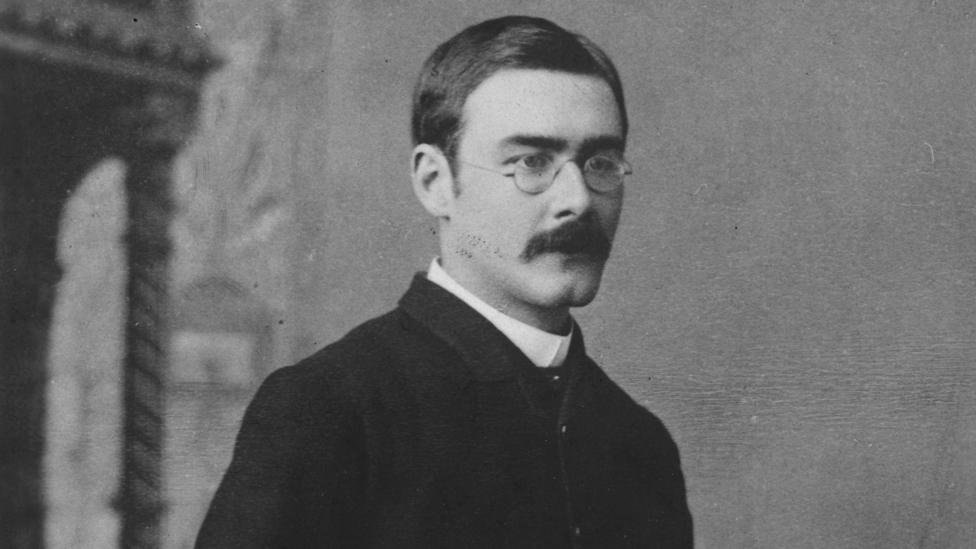
Few writers sit in the uneasy space between admiration and controversy quite like Rudyard Kipling. His stories helped invent the modern adventure tale — jungles filled with talking animals, soldiers navigating distant frontiers, explorers confronting the unknown. Yet the same works also reflect the imperial worldview of the era in which they were written.
To read Kipling today is to step into a cultural crossroads where literature, empire, myth, and childhood imagination intersect.
And the intersection is far more complicated than nostalgia suggests.
The Storyteller of the Imperial Age
Kipling was born in Bombay in 1865, during the height of the British Empire. The world he wrote about was not imagined from afar; it was the world he grew up in. India was not an exotic backdrop to him — it was home.
This dual identity shaped his writing. His stories often portray the empire as a living system of soldiers, administrators, engineers, traders, and wanderers. Unlike many writers of his time, he paid attention to the machinery of empire — the railways, the bureaucracy, the discipline that kept the imperial structure functioning.
But he also infused that world with myth.
Kipling’s landscapes are never merely geographic. They are symbolic terrains where loyalty, duty, danger, and identity collide.
The Jungle That Raised Generations
For millions of readers, Kipling is synonymous with The Jungle Book. The story of Mowgli — the human child raised among wolves — became one of the most enduring narratives in children’s literature.
Yet the jungle in Kipling’s stories is not chaotic wilderness. It is a system governed by rules. The famous “Law of the Jungle” establishes a moral framework that echoes human society: loyalty to the pack, respect for hierarchy, and consequences for betrayal.
It is a jungle shaped by discipline rather than disorder.
The continued global fascination with these stories can be seen in the countless reinterpretations and adaptations, including major film versions documented by institutions such as the British Library’s literary archives, which preserve many of Kipling’s manuscripts and historical materials.
The jungle was never simply an animal story. It was a mirror.
The Adventure Blueprint
Kipling also helped define the template for modern adventure fiction. The rhythm of his stories — distant landscapes, moral tests, dangerous journeys — became the blueprint for later writers such as Jack London and H. Rider Haggard.
Adventure, in Kipling’s hands, was rarely pure escapism. It was a test of character.
Soldiers confront loyalty. Travelers confront unfamiliar cultures. Children confront responsibility. Even the jungle animals confront moral law.
The adventure story becomes an ethical experiment.
The Shadow of Empire
Yet Kipling’s work cannot be separated from the imperial ideology that shaped it. Some of his writings celebrate the British Empire openly, presenting it as a civilizing force and a global system of order.
For modern readers, this perspective raises difficult questions. Can the literary achievements of Kipling be separated from the political worldview embedded within them?
The debate continues. Scholars, readers, and critics revisit his work constantly, attempting to balance admiration for his storytelling with awareness of its historical context.
Literature rarely exists outside the values of its time.
Why Kipling Still Matters
Despite the controversies, Kipling’s influence remains immense. His storytelling techniques — vivid landscapes, symbolic animals, disciplined narrative structure — shaped the evolution of modern adventure literature and children’s storytelling alike.

More importantly, his work captures a specific historical moment when the world was becoming interconnected through railways, colonial administration, and global trade. His stories document how people imagined that expanding world.
In that sense, Kipling is not simply a writer of empire.
He is a writer of transition.
Artists who explore symbolic narratives about power, systems, and society often engage with similar themes — a process of translating complex structures into visual or narrative allegory, much like the symbolic critiques examined in Art-Sheep’s exploration of Pawel Kuczynski’s visual satire.
Stories change form. The questions beneath them remain.
The Jungle Still Echoes
Kipling’s world of soldiers, wolves, jungles, and imperial frontiers may belong to another century, but the narrative instincts he shaped continue to influence literature, cinema, and popular storytelling.
Adventure remains one of humanity’s favorite narrative engines.
And somewhere in the background of many modern adventure tales — from fantasy epics to survival dramas — you can still hear the faint echo of the jungle law.
Not chaos.
Order.
And the stories that grow out of it.